Collisions involving trains and cars feel like something out of an old-timey movie--a villain silently laughing in the background as a train gets closer and closer to the hero’s car stuck on the tracks. Now, railroad crossing signs and signals give drivers plenty of time to stop when there’s an approaching train. Afterall, automated railroad crossing gates have been around since the 1930s.
With all the safety features in place, it may be surprising to hear that there were more than 1,600 collisions between vehicles and freight and commuter trains in 2021, and almost 500 collisions at transit train crossings the previous year. As a result of these collisions, 133 people were killed, and 644 people were injured.
In most cases, these collisions could’ve been avoided. Keep reading to learn how to stay safe at railroad crossings.
Railroad Signs
It’s important to know and follow railroad crossing signs and signals.
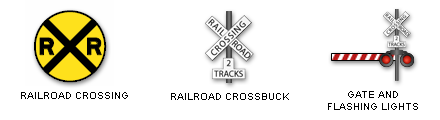
Here are the common signs and signals you’ll encounter at railroad crossings:
- Railroad Crossing: When you see this sign, you are within a few hundred feet of a railroad crossing. Slow down and prepare to stop. Check for trains and if you see one approaching, STOP! Never try to race ahead and beat it across the tracks.
- Railroad Crossbuck: These are posted at every railroad, highway, street or road grade crossing and show the location of the track or tracks. When you approach a railroad crossbuck sign, always slow down, look, listen and be prepared to stop for a train.
- Gates and Flashing Lights: The gate is down when a train is approaching. Stop when you see lights flashing--this means the gate is about to lower. Remain stopped until the gates are raised and the lights stop flashing. As always, use caution when crossing the tracks. Never try to go around a gate. The lights usually continue to flash briefly after the train has passed. Wait until the gate is raised before crossing the tracks.
Keep in mind that some vehicles (e.g., school buses, church buses, and trucks carrying hazardous materials) are required to stop at railroad crossings, even when there is no train approaching. Do not pass these vehicles when they are stopped at railroad tracks. Wait until they have crossed, check for a train yourself, then proceed when it’s safe to do so.
Yield to Trains
The Department of Transportation wants us to keep this in mind: Stop. Trains Can’t.
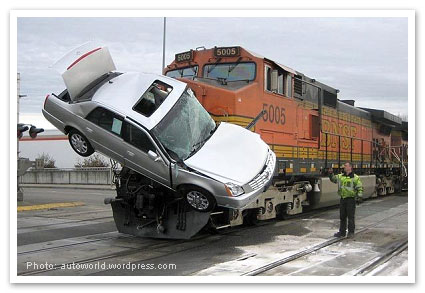
Always yield the right-of-way to trains. They’re a lot bigger than you and traveling at much faster speeds. If your car came in contact with a train, the train would win every time.
Here are some safety tips for railroad crossings:
- Always drive as though you’re expecting a train on any track at any time, even if you’ve never seen a train on a particular crossing.
- Never try to make it across the tracks as the gate is lowering. Do not stop on railroad tracks. You should never begin to cross railroad tracks unless they can be safely cleared without stopping.
- Be sure all tracks are clear before you proceed across. There may be two or more sets of tracks.
- Watch for additional trains. When there is more than one track, you have to be sure that another train isn’t coming on the other track once the first train has cleared. Make sure a train isn’t proceeding in the opposite direction behind the first train.
- Railroad gates aren’t meant to keep you locked in the crossing. If you do happen to get stuck on railroad tracks while the gates are down, you can drive through the gates and you will be able to knock them out of your way in order to safely get out of a train’s path.
- If your vehicle stops or stalls on railroad tracks, everyone in the vehicle should exit immediately. Get off the tracks, and run in the direction the train is coming from. You could be hit by debris when the train hits your car if you run in the same direction as the train is heading. Call for help.
Collisions with trains are scary and deadly. Please be careful--beating a train across the tracks is never worth the risk.
Want to learn more?
Are you looking for defensive driving and traffic school courses? Do you want a discount on your auto insurance? Are you a mature driver interested in a discount on your auto insurance? Do you have a teen who’s ready to take an online driver education course?
Safe2Drive is here to help! We offer convenient online courses for drivers of any age! Visit our website today to learn about the online courses we offer in your state.